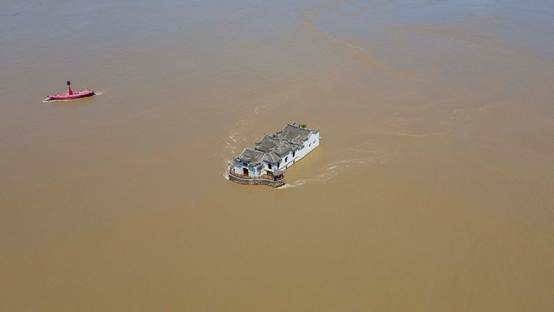

There is a famous Guanyin temple on the Yangtze River called Ezhou Guanyin Pavilion. This temple is located on the banks of the Yangtze River in Ezhou, Hubei Province, China. Due to its unique geographical location and architectural design, it has remained intact despite numerous flood invasions, making it an important symbol of local faith.
Ezhou Guanyin Pavilion is not only a religious site but also an important part of local culture, attracting a large number of worshippers and tourists. Local people believe that the divine power of Guanyin Bodhisattva can protect the city and ensure peace, especially during floods.
As a result, Ezhou Guanyin Pavilion has become an important landmark that connects nature with spirituality, as well as culture with faith.
From the perspective of traditional Chinese metaphysics and Feng Shui, the existence of the Guanyin Pavilion is imbued with profound symbolic meaning and cosmology.

1. Feng Shui and Metaphysical Views
The temple may sit on a “dragon vein” with water forming a “jade belt,” gathering auspicious energy.
The reef on which the pavilion stands is named “龙蟠矶” which translates to “Dragon Coiling Reef”. In Chinese culture and Feng Shui, the dragon is a supreme mythical creature that controls clouds and rain, representing immense natural power. Building a temple on the “dragon’s back” carries the symbolic meaning of “suppressing the dragon” or coexisting harmoniously with it, aiming to pacify the water spirits and pray for the peace of the river, thereby averting floods. This is considered a location of powerful energy and auspicious Feng Shui.
Building a temple dedicated to her on the banks of the flood-prone Yangtze River is in itself an act of spiritual solace and religious prayer. Worshippers believe that it is the divine power of Guanyin that suppresses the water monsters in the river, protecting the city of Ezhou and passing boats with her boundless power. The fact that the temple withstands repeated inundation without being destroyed is seen as clear evidence of the Bodhisattva’s divine presence and immense power.
Guanyin’s compassion is believed to suppress floods, embodying a spiritual shield.
In metaphysical thought, this fusion is believed to gather the positive energies of different belief systems, creating a stronger and more stable spiritual and energy field that collectively protects the structure.

2. Folklore
Local folklore adds a thick layer of mystery to the Guanyin Pavilion, serving as the public’s poetic interpretation of this miracle.
A widely circulated legend tells that the true form of the Longpanji reef is a giant divine turtle. Enlightened by Guanyin Bodhisattva, this turtle has remained dormant in the heart of the river for ages, carrying the Guanyin Pavilion on its hard shell. Whenever floods come, the turtle is said to rise slightly or use its divine power to stabilize the pavilion, protecting it from being washed away. Therefore, what people see is not just a building, but a sacred place guarded by a divine turtle.
Legends say the Guanyin statue glows to repel floods, or temple bells ring autonomously as warnings. Some claim a flood-causing “water dragon” is trapped beneath the temple by her power.
Local folklore adds a thick layer of mystery to the Guanyin Pavilion, serving as the public’s poetic interpretation of this miracle.
In conclusion, the ability of the Ezhou Guanyin Pavilion to withstand centuries of floods and remain standing is the result of multiple contributing factors. It is supported by the “hardware” of a solid natural foundation and a scientific architectural design that shines with the wisdom of the ancients. It also carries the “software” soul of profound Feng Shui beliefs, religious protection, and beautiful folklore. This makes the Guanyin Pavilion not just an architectural marvel, but also a unique landmark that integrates science, spirituality, and culture.


Leave a Reply